
October 17, 2023
Status of Conestogo Iron Bridge
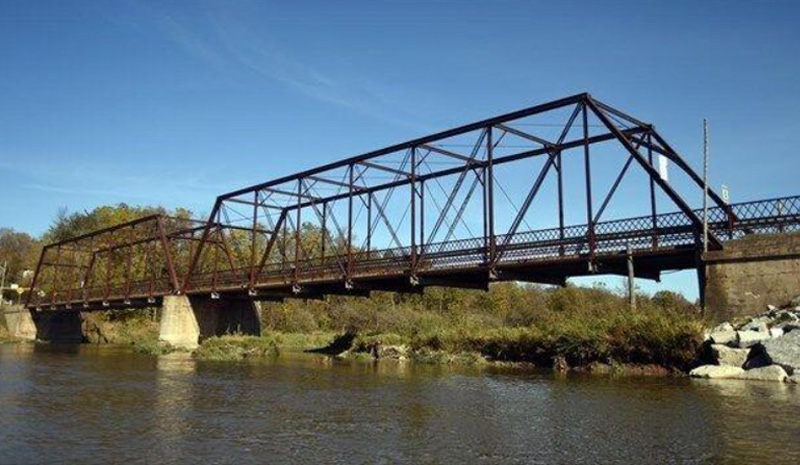
Many local Conestogo residents have pretty much given up on using the Glasgow St. bridge. But it’s still there, and to a limited extent at least, still being used.
As far as I can tell the status and future of the bridge were determined in 2019 when it was decided to make minimal structural improvements and, most importantly, limit general traffic to one way – southbound towards Waterloo. A few exceptions are made using a “contraflow lane” (northbound) – Cyclists and horse and buggy traffic.
If you’ve tried to use the bridge going north you will have noticed that there is a “turnaround” on the south side, which is your cue to turn around and go back where you came from.
The official township notice is here.

About Author

Rick
2 Comments
As a retired geography teacher and WHS member, I post slideshows of regional interest, including about this bridge (https://youtu.be/TO4h3WbguJQ). The YouTube description includes historical information: “The Glasgow Street Conestogo Bridge rates highly in historic value as one of Canada’s oldest bridges of its type and Waterloo Region’s only example of a double span Pratt through truss bridge. Situated on the scenic Conestogo Flats upstream of the Conestogo River’s confluence with the Grand River, this single lane, double-span steel truss bridge was built by Hamilton Bridge Company in 1886 and rehabilitated in 1928 when it was moved to its current location. With an overall length of 80 metres (261 ft), it comprises two spans measuring 40 m (131 ft) long, 5.5 m wide and 4.5 m vertical clearance over a transverse laminated wood deck with an asphalt paved surface. The load limit of 5 tonnes was imposed in 1989 during temporary rehabilitation.
Owned by the Township of Woolwich (bridge No. WC3) and also known as the ‘Conestogo Bridge’ and ‘Bridge 25’, it was rehabilitated again in 2019 with the federal and provincial governments contributing $1.2 million of the $1.4 million cost. At that time, it was designated a one-way bridge to only carry traffic south with the 5 tonne load limit continuing.
The Conestogo River is one of four major tributaries of Ontario’s historic Grand River. Pennsylvania-German Mennonites who migrated north using the famous horse-drawn Conestoga wagon settled its valley in the nineteenth century.
Today’s 275 kilometre Grand River originated 13,000 years ago as a meltwater channel at the end of the Laurentide glaciation. Although the village of Conestogo was settled by Pennsylvania Mennonites around 1820, the Grand valley was the home of the Attawandaron (Neutrals) until their extirpation in the 17th century Iroquoian ‘Beaver Wars’.
This video is one of an ongoing series on the bridges of Waterloo Region. Some recent instalments include “Grand River Fairway Road Bridge Panorama, Kitchener ON Canada” (https://youtu.be/nGTfaqTMVnA), “Grand River Peel Street Bridge Fall, Winterbourne ON Canada” (https://youtu.be/6GaHDU-YatA) and “Grand River Craig’s Crossing Pedestrian Bridge, Cambridge ON Canada” (https://youtu.be/XQFgV7ERwk0)
Thanks very much for such valuable information.