
The Stevensville Cider Mill
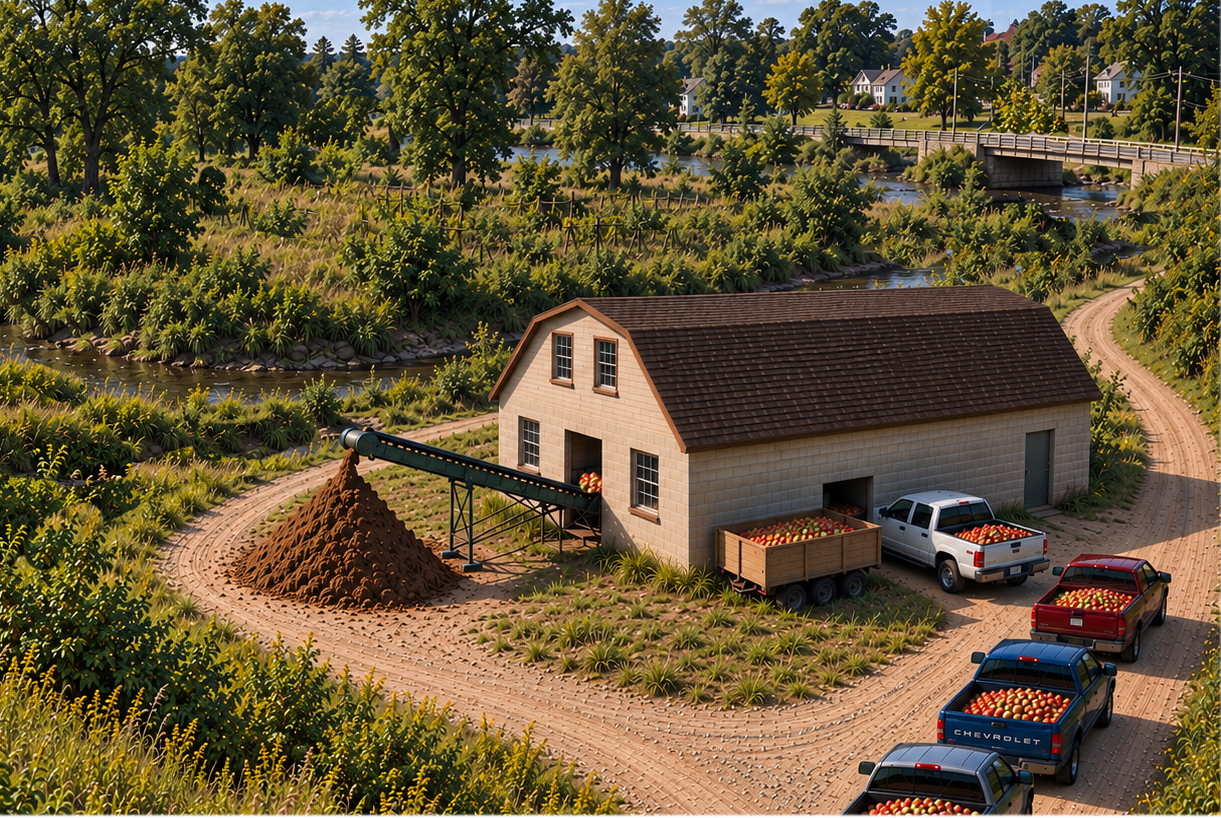
Here’s a rendition of the Stevensville Cider Mill as I, more or less, remember it. This image was produced by ChatGPT after many edits and modifications.
In another post I comment on the difficulty of coaxing an AI program to give you just what you want. For example, the Creek directly behind the Mill was actually a stretch of the original Creek channel which was replaced by a straighter, more direct channel further behind it. Chat GPT had a lot of trouble getting its “head” around this concept and I had to make manual modifications in Photoshop.
The original abandoned creek channel was effectively just a ditch as I remember it back in the late 50s and early 60s. It had very little water in it. We would cross over to the “Island” behind it via a little walkway created at the east end (right side).
In another post I outline how the Creek (“the crik” or officially “Black Creek) was modified during the 50s and 60s, to make it flow more consistently and not flood so dramatically in the spring.
The “Island” created by the diversion of the creek in the late 1950s was a perfect place for kids in their pre- and early teens to fool around in. Nobody seemed to own the place and nobody ever went there. My friends and I eventually built a “shack” along the creek (new channel) with lumber we “found” at the Planing Mill upstream.
The Mill was located down a makeshift road between the Gilmour and Plyley homes and sat more or less behind John Gilmour’s house.
The Cider Mill itself was originally owned and operated by Charlie Wale, and passed on to Lloyd Wale, his nephew, who operated “Wales Plumbing and Heating” located at the corner of Main St. and Stevensville Rd. The Cider Mill operated for a short time during apple and grape season near the end of the summer. In an oral interview local resident Ray Miller notes that “the mill was powered by a large gasoline engine whose sound could be heard two or three miles away.” I can still vividly remember that sound since the Cider Mill was just a few hundred yards from our house.
I can also remember how, during the season, trucks filled with apples would line up all the way past our store and sometimes right down to the corner. When the Mill was finally shut down for good in the early 60s it was turned into a storage shed.
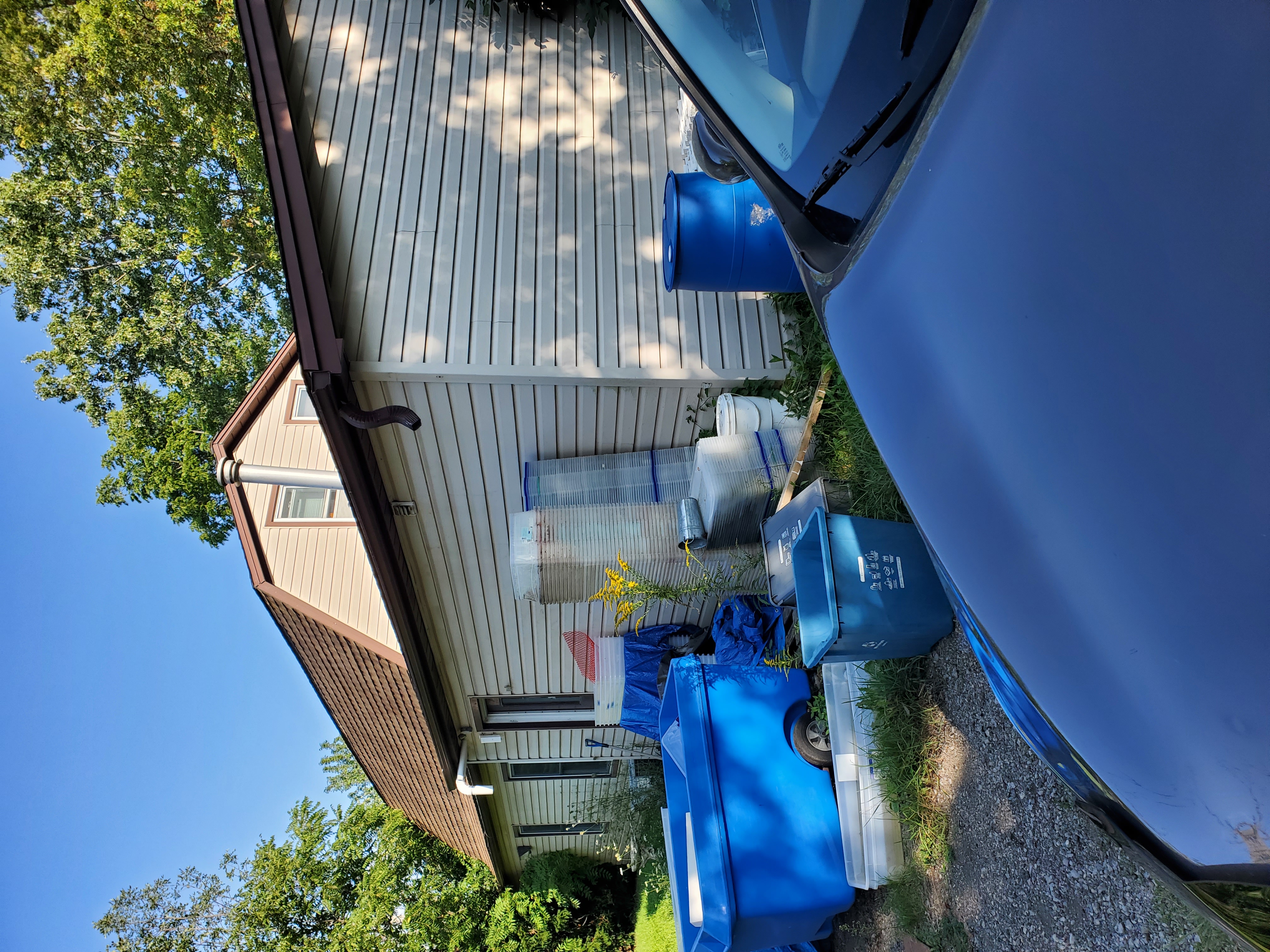
We recently drove down to the building that is still at this location. There is junk lying around and the access to the Island has completely grown over with dense vegetation. You wouldn’t even know it was down there. In my initial recollection of the building as it was back in the 60s I remembered it as just a basic one story building with a plain roof. Looking at the picture I had taken when we visited the site I noticed the “barn style” roof design and had ChatGPT change my rendition to incorporate that design.
I really don’t remember that feature of the building but it makes it look cooler so I left it.
Another feature of the old Mill is the conveyor system and sludge pile in front of the building. Having grown up with this image I just assumed it was a feature of cider mills in Ontario. When I started attending WLU (in Waterloo) in 1966 from my residence window I could see – guess what: a Cider Mill – right there on the corner of University and King, virtually as part of the University. But it didn’t have a conveyor and sludge pile like I was familiar with. That just reinforced my appreciation for the uniqueness of the one in Stevensville.
By the next year the university cider mill was gone, and I am pretty sure that I was one of the few students who saw it there and appreciated how unique it was.

Local 15 year old, Kaitlyn Leis pilots No. 9 engine of the Waterloo Central Railway

How Conestogo Ontario Got Its Name – Part 1

Tecumseh fights for a pan-Indian homeland
About Author

Wow – what a great story Rick, thank you for sharing. It was gone when I was quite young, as I am a 1958 little one – but sure was in the neighbourhood. Happy to hear any other Stevensville stories, remember your family store well – wishing it was a little bit more like it was then.
Thanks for the comment Judith. I’m working on several other articles and will be posting them in the next few weeks. The first one is a history of the creek: how it was used to power a number of mills in the early days, how it was modified in the 50s and 60s, and just generally how it has been at the heart of the town as the years have gone by. I will also be looking at the role of the railway lines which have been front and centre for as long as I can remember, but which most people in Stevensville know very little about.
If you have access to any photos you think would be of interest to Stevensville people you can share them by carefully taking a photo of them and emailing them to me along with a brief description. Full credit will always be given.