
Early Black Creek Mills in Stevensville
If you know anything about the history of Stevensville you are probably familiar with the place of the Stevensville Planing Mill in that history. The Stevensville Planing Mill was originally operating as early as 1898 in the location on the bank of Black Creek opposite Coral Avenue.
But there were other mills of various kinds and sizes that operated in Stevensville before this. In fact it is possible that the Planing Mill (owned by Samuel B. House and passed on to his son Wilfred House) operated at the same location as a previous mill (see below).
The fact is, Stevensville’s very existence came about because of its location on Black Creek and the large number of hardwood trees along its banks. Over the years from the founding of Stevensville in the late 1700s various mills along the creek turned this hardwood into marketable lumber for use in local construction projects or floated down the creek on rafts to the Niagara River “and then over the river to Tonawanda where it was generally sold for shipment to the seaboard.” (p.130)
As one older resident of the area recalled in an interview with Elaine Winger (in 1984), “There was a great deal of lumber in the Stevensville area at that time and large piles of lumber were seen in many areas. Teams of horses hauled much of this lumber to Buffalo.” (p.94)
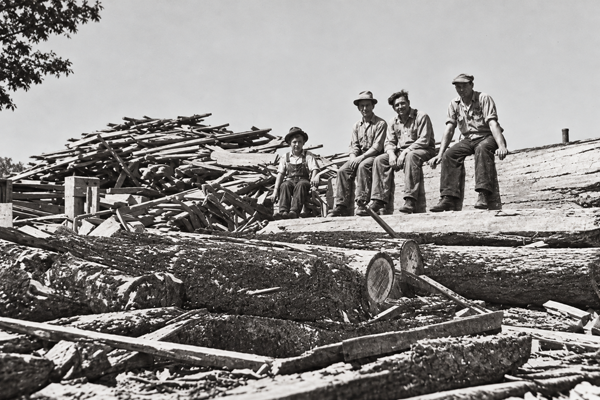
This is a cleaned up photo from “Our Town Stevensville…” It dates from 1942 and shows a number of workers at a mill jointly owned by Hubert Hendershot and John Morningstar, located on the south corner of East Ave. and Hendershot Dr. This suggests that lumber milling along Black Creek was common until at least the end of World War II. In my own experience in the late 50s and early 60s this type of activity had essentially disappeared.
Mills before the Stevensville Planing Mill (1900)
From my research to date I have identified a number of mills that operated along Black Creek during the period before the Stevensville Planing Mill was established (roughly 1900). I’m sure there were more.
Mill 1 – The Haun mill on Black Creek
Bertie Township records from May 1832 indicate that John Haun sold 100 acres in Lot 11, Concession 13 (from the Niagara River) to Wilson Haun (his brother) not including “one-half of a sawmill, together with its water rights and privileges”. Another record from 1834 mentions “…the mill dam”.
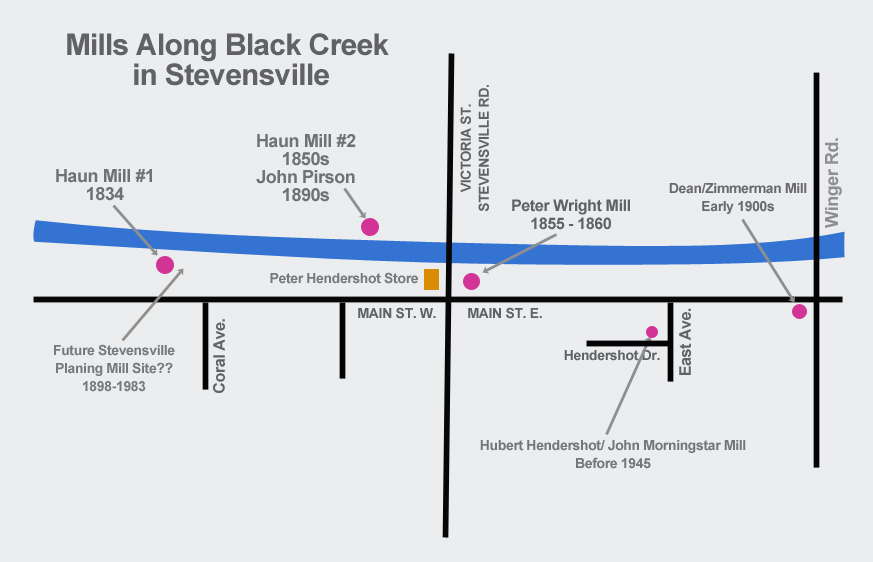
Note that this refers to an already existing saw mill as well as a dam on Black Creek. This was in 1834. Other references indicate that the location mentioned is roughly 1 mile upstream from the Victoria St. bridge (Stevensville Road). This makes it suspiciously similar to the site eventually occupied by the Stevensville Planing Mill.
From my own recollections in the early 1960s, here is another interesting fact: there was a partially demolished dam in the middle of the creek just a few feet downstream from the Planing Mill. Could this be remnants of the “mill dam” mentioned in the 1834 records?
Back then Mill #1, the Haun mill, was a sawmill, and these records make it pretty likely that the Haun Mill was one of the earliest mills in Stevensville. And furthermore they suggest that Mill #1 may have been operating on the site of what became the Stevensville Planing Mill in 1898.
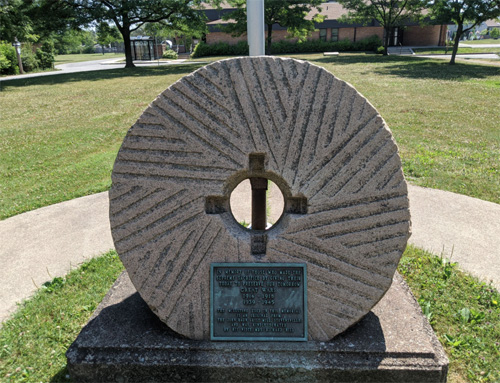
Another thing we know is that a surviving millstone, now incorporated into the Stevensville war memorial west of Ott Rd., came from John Haun’s grist mill on Black Creek. So it is clear that the Haun Mill operating in the mid-1800s also included a grist mill.
Mill #1 adds a Grist Mill
The first mention of the grist mill addition was in a Bertie Township record dated Sept. 16, 1850. As we previously saw, the part owner of the original Haun mill complex was Wilson Haun. Now in 1850 he sold his interest to Mathias J. Haun. This included his half-interest in the sawmill and all of the grist mill. This clearly suggests that a grist mill had been added to the complex before 1850.
As ChatGPT put it…
That fits the early economy of the Stevensville area very well. The sawmill would have converted the surrounding forest into construction lumber, while the later grist mill served the growing agricultural settlement by grinding locally produced grain.
Mill #2 on Black Creek?
Other records suggest that there was a second location developed by one of the Hauns in the mid 1800s. Eventually, in the 1890s, John H. Haun, a successor to earlier members of his family, sold two family milling operations to two different people or groups of people.
The original saw mill (Mill #1) was sold to J.H. Weaver in the late 1890s. And then a second location (Mill #2) was taken over by “Pirson and Johnson” in the early to mid 1890s. The “Pirson” referred to here was John Pirson. There is other confirming evidence that the John Pirson mill operation (Mill #2) was located downstream from the original Haun Mill site, on the north side of the creek fairly close to Victoria St. (and the bridge).
Incidentally, back in the late 1950s the remnants of a dam stood right in the middle of the creek just downstream from “the Island” and very close to the location of the John Pirson mill ruins (#2 Mill). Was this dam associated with the John Pirson mill? I have no reason to think this other than
a) its location near the John Pirson mill ruins, and
b) its similarity to the dam ruins upstream at #1 Mill. You will recall that both of these mills (#1 Mill and #2 Mill) were both built and initially operated by members of the Haun family.
Summary of Mills #1 and #2
To summarize what we have discovered so far:
1. The Haun family operated an early saw mill (Mill #1) from as early as the 1830s at a location roughly 1 mile upstream from what became the town core. In the historical records there was a dam associated with Mill #1. There are dam ruins in Black Creek slightly downstream from the Stevensville Planing Mill site.
2. A grist mill was added to Mill #1 some time before 1850.
3. A second mill (Mill #2) was developed by the Haun family later in the 1800s. Mill #2 eventually included a grist mill. The operation was located further downstream towards the bridge.
4. In the late 1950s there were ruins of a dam in the middle of Black Creek very close to the ruins of the John Pirson mill.
5. Both mills were off-loaded in the 1890s. Mill #1 was sold to J.H.Weaver, and Mill #2 was “succeeded in the grist and saw mills by Pirson & Johnson”.
6. We don’t know if J.H.Weaver continued to operate Mill #1, but clearly the location and equipment remained, and we have speculated that this location was eventually taken over by Samuel House in 1898. As we will see, House did not start from scratch. He took over an existing building with milling equipment.
7. As we will see, John Pirson with the help of his son Fred continued to operate both the saw and grist mills at Mill #2 into the 1900s.
Today there is a street running back from Stevensville Road for a block or two called Pirson St. This was very likely the access road to John Pirson’s mill. I personally remember searching through this area when I was a young boy, climbing with a couple of friends through the ruins of what we were told back then (in the late 1950s) were the ruins of an old mill.
This may very well have been Mill #2, and it was more or less directly across the creek from the property on West Main St. where my parents’ store was located.
Incidentally we know that John Haun was still active in the building trade in 1884 when he built the original Hutcheon House, otherwise known as the Stevensville Hotel.
A bit about John Pirson
With regard to the John Pirson mills, we know that his son Fred worked with his father for a number of years, and also that the mill burned down some time before the 1940s. There may be a connection to what became Beam’s “Flour and Feed Mill”, originally started by Chester Beam around this time in a building on the east side of Victoria St. (Stevensville Rd.), more or less opposite Pirson Rd. But I have not been able to confirm such a connection.
Just as an aside, John Pirson, like many entrepreneurs of that era, was involved in a number of other businesses. In the Hubert Hendershot interview Hubert mentions “a barrel factory across from John Pirson’s sawmill. This factory was also owned by John Pirson” (p.136). In the Lloyd Wale interview Lloyd mentions, “John Pirson, who operated the sawmill on Pirson Road was also a road contractor. He built the railroad bridge over the QEW, between Niagara Falls and St. Catharines. Mr. Pirson also went down to Florida and bought a parcel of land, intending to build up a sawmill business there, but he went broke.” (p.120)
And in Elaine Winger’s “Imaginary Walk Through Stevensville” she recounts that “At one time there was a large grapeyard, owned by John Pirson, in the area between the sawmill and the railroad tracks. Grapes were sold to factories for canning and making wine.”(p.59) Apparently Pirson had planted this vineyard after his sawmill burned down. I actually remember, on more than one occasion, walking through that old vineyard in the early 60s. It had long before that time fallen into complete disrepair and many of the posts were lying on the ground.
A Couple More Sawmills in the early 1900s
Two other sawmills operating in the early 1900s are mentioned in the Elaine Winger book. First, there is the one mentioned above operated by Hubert Hendershot and John Morningstar until after 1945. This one was located near or at the corner of Hendershot Ave. and East Ave. in the east end of town. The creek was just across the Main St. (a block away) and down a slight grade.
And also, perhaps more significant, is one operated “at the east end of Stevensville on the corner of East Main Street, and Winger Road.”(p.94) This would be very near where the town dump was eventually established on Winger Road. This mill was operated by Ben Dean, and later by Frank Zimmerman and Dave Dean. As happened to so many other businesses in Stevensville this one eventually burned down in 1920.
Developments in the mid 1800s
The period around the middle of the 1800s (1850-1860) was a period of significant commercial activity in Stevensville. This was particularly the case with developments near the core of the town – near the bridge, and at the intersection of Main St. and Stevensville Road (Victoria St.).
This is what we might call the 1st Period of Stevensville Business Expansion. Two 1850 businesses in particular are at the centre of our story: First, the Peter Hendershot store located where the Stevensville Hotel would later be constructed. And second, the Peter Wright mill complex established in 1855 across Stevensville Rd. (Victoria St.) where the “building at the corner” would later be built (in 1908). This is what I refer to here as “Mill #3”.
Both of these businesses were constructed in the core area of Stevensville by aggressive entrepreneurs looking to take advantage of the growing commercial activity in Stevensville during this period.
Who was Peter Hendershot?
Because of the prominent location of the Peter Hendershot stores located on the northwest corner of Main and Victoria it is somewhat interesting to ask “Who was this Peter Hendershot, and what was his relationship to the other Stevensville Hendershot, namely Paul Horton Hendershot who a bit later came to run a significant orchard east of town (The Stevensville Apple Orchard)?
In fact these two (Peter and Paul Hendershot) were brothers, sons of Abraham Hendershot. Abraham was the son of one of the original United Empire Loyalists to come to the Niagara Peninsula after the American Revolutionary War in the late 1700s. These two loyalists were John and Peter who came to Pelham Township in 1792.
John was later killed in the Battle of Queenston Heights in the War of 1812. Meanwhile Peter became a highly successful farmer who became a friend of General Isaac Brock and supplied the British Army with “large quantities of beef and other supplies” (193, “Geneaology of the Hendershot Family in America”).
This original Canadian Peter had 11 children, one of which was Abraham, born in 1807. Among other things Abraham was “a tavern keeper near Wellandport (on what is now called ‘Hendershot Road’). Like several of his siblings Abraham was a successful entrepreneur.
Eventually in 1848 he moved with his family to Stevensville. By 1856, just 8 years later, his son Peter had established the Hendershot Store on the main corner. This was an extensive operation, and Peter actually lived at that location as well. When I asked ChatGPT to research where Abraham lived, this is what I got
“Peter Hendershot appears to have lived in the store-and-dwelling complex on the northwest corner of Main and Victoria — the site later occupied by the Stevensville Hotel — until it burned in 1860. His father Abraham probably lived and worked nearby, possibly in the same family commercial premises, but Abraham’s exact Stevensville residence has not yet been documented.
Records indicate that there was actually a tavern on the location when the Hendershot’s bought the property at the corner – called “McCarty House Tavern”. And given Abraham’s previous experience as a “tavern keeper”, there is a good chance he moved to Stevensville to take over and develop the already existing McCarty House Tavern. (my speculation)
As we will see, after just about 5 years of operation in Stevensville, Peter Hendershot’s store burned down, probably as a result of arson. To save some of his stock he had it moved to a building on the Peter Wright property across the street.
And then the Wright business was destroyed by fire a few weeks later. Some accounts say Peter Hendershot did not have insurance, but in fact, “He was insured in the Old Niagara District Fire Insurance Co., which was regarded, at the time, as a strong company, but to the surprise of all, completely collapsed soon after this fire.” (p.128)
As a result Peter Hendershot left Stevensville and “he conducted a large general store at Niagara Falls. Then a wholesale grocery business in the city of St. Catharines.”(p.128)
Back to the Bigger Picture of Stevensville in the mid 1800s
As previously mentioned Stevensville had become a centre of lumber milling because of the extensive forests in that region of Bertie township. These milling enterprises were taking advantage of the water power and transportation possibilities of Black Creek. At the same time farming was rapidly expanding in the area. and commercial operations like the vineyards of John Pirson and, a few years later, the apple orchard and vineyards of Paul Hendershot made Stevensville a hub of commercial activity.
As a newspaper article written more than a hundred years later in the 1980s says:
“In the middle 1800s, the village enjoyed a thriving lumber trade. Forest abounded in all directions. Then Peter Write was Stevensville’s prime businessman. He owned the flour, saw and planning mills, a blacksmith’s shop and some stores, which all attracted a large trade from the surrounding Welland County.
At times the lumber trade was so brisk, the roads were almost blocked with logs and the mills were pushed to their fullest capacity. (The Village of Stevensville).
Mill #3 – the Peter Wright Mills
So here we are in 1850 with Stevensville in the middle of a “brisk” lumber trade. Mill #1 (Haun family) is presumably still operational up the creek a mile or so, the 2nd Haun saw and grist mill (Mill #2) is presumably chugging along down near the bridge on the north side of Black Creek. And a few more private business operations had started in town and were flourishing.
This is the point at which Peter Wright decided a serious mill operation should be built right in the centre of town.
Peter Spetigue Wright was a major Stevensville industrialist of the 1850s. From land purchase records of that period we know that Wright sold his property holdings in Stamford Township in the early 1850s. He then began assembling land beside Black Creek in Stevensville in 1855.
We don’t know why he chose Stevensville. It could have been that he just saw opportunity there. Or it could have also been that he had contacts with the Peter Hendershot family. The fact that they both undertook significant operations at the same time (early 1850s), and at essentially the same location certainly suggests some relationship.
It is also interesting that after the fire destroyed his mills in Stevensville, settling his affairs, selling his property holdings, and clearing away various mortgages involved dealings with William B. Hendershot, Abraham’s brother and Peter’s uncle.
It is well known that William B. Hendershot was a highly successful businessman from Thorold who owned some of the largest flour mills in Canada. He had been mayor of Thorold and also a member of the Legislature for many years. It is also well documented that he helped many local businessmen get established – including many members of the Hendershot family such as Abraham (his brother) and Peter (his nephew).
Be that as it may, Peter Wright’s mill (Mill #3) was a substantial industrial complex that included a three-storey commercial flour mill, sawmill, planing facilities, machine or blacksmith shop, and stores.
The whole complex was in the core of Stevensville. It stood on the northeast side of Victoria Street, immediately north of Main Street and beside the creek. It was right across the street from Peter Hendershot’s store, and the two businesses certainly worked in tandem to take advantage of the booming lumber and agricultural activities that were then at their peak.
The Fire that Destroyed Peter Wright’s Mill
In March 1860, only weeks after the destruction of Peter Hendershot’s store across the street, Wright’s mills and shops were destroyed by a fire suspected of being deliberately set. Wright did not rebuild the complex. His remaining Stevensville properties were disposed of through a series of transactions completed by 1863. Records indicate that Wright returned to or resumed residence in Stamford Township, where he lived until 1895.
These fires put a major damper on the economy of Stevensville. As related in an article published in the Elaine Winger book: “With the exception of Hendershot’s store, which was built on the opposite side of the street and occupied by F. H. Allen, none of these businesses were revived for many years and the Stevensville economy suffered greatly.”(Village Intact)
After a Pause Stevensville’s Economy Revives
This was several decades before what we might call the 2nd Stevensville Business Renaissance that took place in the years around 1900. This 2nd Renaissance included the expansion of John Pirson’s saw and grist mill activities on the north shore of Black Creek not far from the bridge.
This era also included the building of Hutcheon House (the Stevensville Hotel) by John H. Haun in 1884 at the northwest corner of Main St. W. and Stevensville Rd., the opening of the Stevensville Planing Mill in 1898, and the construction in 1908 by Samuel House of the large “building at the corner” on the other side of Stevensville Rd. that today houses Mae’s Restaurant. Back then it was the location of a bank and a large general store operated by William (Pat) Robinson. Many other local Stevensville businesses also got their start in this period after 1900.
Telephone service also came to Stevensville in 1899. The modern era had begun!
In the next Stevensville history post we will focus on the Stevensville Planing Mill.

Local 15 year old, Kaitlyn Leis pilots No. 9 engine of the Waterloo Central Railway
The Stevensville Apple Orchard

Responsible government and voting in early Canada
About Author

I believe rhe Pirson Mill fire was early 1930s, as I understand they were bankrupt in 1932.
I think I have accidentally deleted a couple of comments. I’m really sorry. I consider them extremely valuable.
Hi Judy,
Thanks for that. Interesting how fires tend to go along with bankruptcies.
Very interesting history. Thank you.